Design Shack - Web design showcase, CSS tutorials and web standards


Dedicated Server Hosting Beautiful Premium WordPress Themes & CSS Menus


About

Design Shack showcases inspiring web design, alongside resources and tutorials for you to succeed in the same way. It is carefully curated and edited by Josh Johnson and David Appleyard.


Part of the Smashing Network

What to Do if Someone Steals Your Design


Written by Joshua Johnson, On 12th March 2010.
Filed in Business, Graphics, Inspiration.


Protecting your intellectual property has always been a difficult task and the Internet has only served to complicate matters. The web has become an unoriginal designer’s one stop shop for endless material to shamelessly ripoff. Today we’ll take a look into some of the reasons design theft is so rampant online and explore some answers to the essential question of what to do if someone steals your design. A big thanks to Von Glitschka for providing much of the content and advice seen below!

The Problem

Putting your work on the web gives you next to zero control over who views that content and what they do with it. Your portfolio site could be stomping grounds for someone looking for a quick logo design, website layout, etc. One of the main issues here is that it’s so easy to just grab a piece of artwork off of someone’s site, reproduce it, sell it and never get caught. It’s also virtually impossibly to monitor this kind of theft to any successful degree without significant resources. The best you can do on your own is merely hope that no one is stealing your work and that you or someone else will notice if it ever does happen (learn how to obtain commercial protection below).

A Fine Line

Another major problem is defining what exactly constitutes a theft of intellectual property. The online design community is currently obese with daily doses of “inspiration” contained in blog posts. We designers post and use this content to admittedly influence our own projects. Browsing the designs of others can give you great ideas for color schemes, theme ideas, graphical styles, layout alternatives and any number of other possibilities.

However, there is an immensely fuzzy line between inspiration and theft. Exactly where that line lies is perhaps different for every designer. My best advice is to consciously avoid ripping off the ideas of others by using inspirational artwork as a leaping point for your own significantly different creation. Unfortunately, even if you’re on your best behavior, there’s still no shortage of people out there that aren’t so honest. To prove my point, let’s look at some real life examples from an artist who seems to have quite the ongoing struggle with this very issue.

The Vonster Scandals

Anyone active in the online design community has probably heard or seen a thing or two from Von Glitschka (@vonster for my fellow Twits). Von is an amazingly talented Illustrator with a portfolio rich in impressive character illustrations, hand drawn lettering and logo designs. Unfortunately, as Von has discovered, you can make people like your work so much that they want to claim it as their own. He frequently encounters instances of companies or individuals using and/or selling his artwork completely without consent (a whopping 16 times in 2009 alone!).

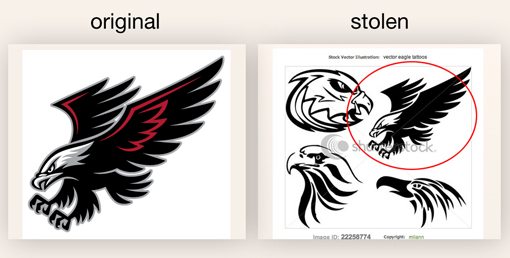
Hawk Mascot
screenshot

The original artwork above was not only ripped off, but actually uploaded to a stock art site to sell to other designers! The ignorance this thief showed towards the likelihood of someone finding this is quite remarkable!

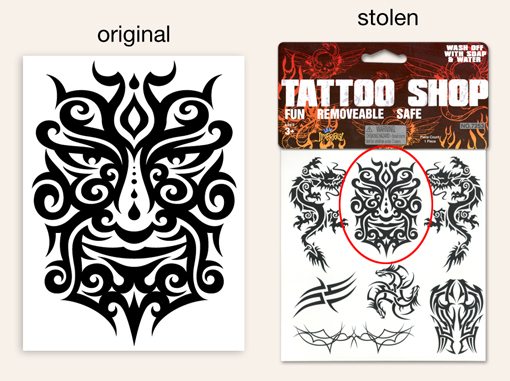
Tribal Tattoo Face
screenshot

In this instance a toy company grabbed Von’s artwork and sold it in the real world as part of a children’s temporary tattoo package. It definitely makes you wonder where the other tattoo art came from as well!

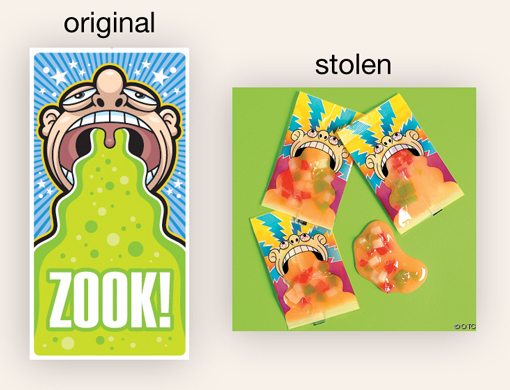
Barf Bag Art
screenshot

As you can see in the images above, the theft isn’t always an outright copy of the art as with the previous two examples. This artist took the time to adjust the facial features a bit, no doubt to give themselves a little arguing room should they get caught. Here we see that fine line between inspiration and theft being flirted with. Some might say that the final result is different enough than the original to no justify theft, however I disagree completely (and so did Von). The angle of the head, the shape of the cheek line and teeth, the oval nostril holes, and the waviness lines of the spew are all far too similar for the artist to claim that the artwork is original.

How to Respond

If you find that someone has indeed used your artwork without consent, the easiest thing to do is to get mad (or even flattered) and brush it off as out of your control. The most difficult thing to do is launch a wildly expensive and drawn out legal battle that will probably cost you more money than you’ll gain. Both of these reactions are fairly undesirable and shouldn’t necessarily be your first choice. Here are a few tactics to try first (some straight from the Vonster himself).

Report It To The Site Owner

If you notice the infringement on a stock art site or something similar, odds are they have a reporting system in place and actually take copyright infringement very seriously. Recently I encountered just such a situation on one of the Envato marketplaces when another author uploaded a piece of art that seemed indisputably based on my best selling item. I simply clicked a button that said “report item” and gave a brief argument as to why I thought this represented an infringement. Within 24 hours the art was removed and the author had written me an apology for any similarities his artwork bore to my own. The ease of this solution makes it among the best possible, but it applies only in very specific circumstances and won’t even be an option with most infringements you encounter.

Do Your Homework

If the infringement occurs outside of a controlled community, the first thing you need to do is become aware of your rights. The Digital Millennium Copyright Act (DMCA) seems to be the standard piece of legislation that covers you in these circumstances. As Von points out on his blog, you technically own the rights to your own artwork whether you’ve officially filed any paperwork to that end or not. However, possessing an actual legal copyright beforehand makes it much easier to pursue prosecution of the theft.

Write a Copyright Infringement Letter

After you’ve researched a bit and understand your rights, the next step is to contact the company or individual disseminating your artwork without approval. There are guidelines set forth by the DMCA regarding what should be contained in this letter. Fortunately, good old Von has written enough of these that he has created a template that does the work for you. In this letter he outlines each requirement and gives an example sentence for how to address the requirement in the letter.

Hopefully, the infringement letter will be enough to make the offender back down. If you come across as a calm professional, knowledgeable of your rights and intent on resolving the matter, you’ll find that many businesses or individuals will be eager to seek an end the situation before it becomes too serious.

Go Public

One particularly interesting tactic that Vonster discovered was to inform his Twitter followers of the transgression. This can lead to lots of helpful advice and an all out uprising of enraged designers completely willing to flood the offender with angry emails. An angry mob is a lot harder to ignore than a lone complainer!

The Big Guns

Obviously, there are several scenarios where reasonable requests simply don’t appeal to unreasonable people. In these circumstances, you’ll have to find a decently affordable copyright attorney to back you up. Always be mindful of how much time and resources you’re willing to spend to ensure the problem is resolved.

A List of Demands

Upon finding out that your art has been stolen your initial reaction will no doubt be to cry out for retribution. As soon as an attorney enters the matter you might even have a tendency to start thinking about a hefty settlement. My advice for this is to analyze the situation carefully before making any demands.

Obviously, the first thing to request is that your artwork be immediately removed from wherever it is being used. After this, the key question to ask yourself is how much you think the company or individual has unlawfully profited from your artwork. In some circumstances this number could be substantial but in many more instances it will be quite minimal. Try to avoid being greedy as exuberant requests will complicate matters and ensure a negative response from the person or company in question. If you’re unsure as to their profit, it is often appropriate to request a usage fee proportional to what you would’ve charged them for the art in the first place (plus a slight PIA charge of course).

Keep in mind that if your artwork is being used in a commercial product, pulling it off shelves will result in serious financial setbacks for the offending company. This will of course cause them to resist heavily but if you succeed in getting the item pulled know that a little justice has been served simply by that action alone.

Prevention

If you’re concerned that you may become a victim of intellectual property theft, you’ll want to seriously consider sending off the paperwork to copyright certain items you see as high-risk. Other than that, you should explore options for digitally watermarking your images to track and prevent theft. Below are a couple of possible solutions for you to check out.

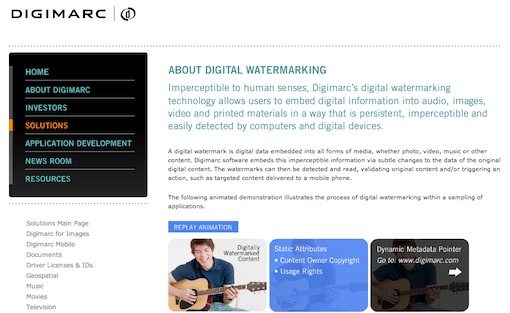
Digimarc
screenshot

“Imperceptible to human senses, Digimarc’s digital watermarking technology allows users to embed digital information into audio, images, video and printed materials in a way that is persistent, imperceptible and easily detected by computers and digital devices.”

Civolution
screenshot

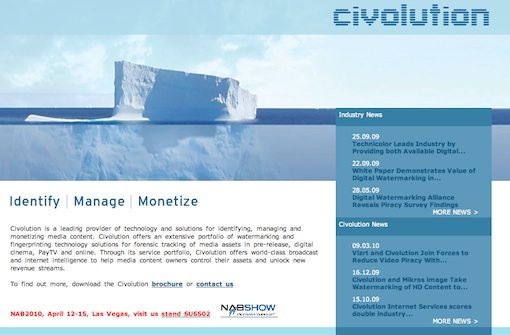
“Civolution is a leading provider of technology and solutions for identifying, managing and monetizing media content. Civolution offers an extensive portfolio of watermarking and fingerprinting technology solutions for forensic tracking of media assets in pre-release, digital cinema, PayTV and online. Through its service portfolio, Civolution offers world-class broadcast and internet intelligence to help media content owners control their assets and unlock new revenue streams.”

Conclusion

Having your artwork stolen is no walk in the park. It’s a messy, time-intensive problem that will do it’s very best to leave you frustrated and tired of fighting. I hope this article has shed a little light into how to respond to this growing problem, before and/or after it occurs to you.

Have you ever had your artwork stolen? Let us hear your stories in the comments below. Be sure to share any advice you have to others going through the same problem.

Like the article? Be sure to subscribe to our RSS feed and follow us on Twitter to stay up on recent content.

25 Comments

  1. dev0347 says:

    Some excellent points, but…

    In most jurisdictions where the concept of copyright exists, there is no paperwork involved in establishing copyright. Your copyright is created by the very act of producing any original copyrightable work. Trademarks need filing, but that is an entirely different issue from what you are describing.

    Using a labelling system like Creative Commons to proclaim the copyright status of your work is extremely useful, however, as it establishes up-front to the law-abiding user (who are the vast majority of your visitors) what they can and cannot do with your work.

    DCMA applies only within the confines of the USA. If you send me a DCMA notification (I’m based in the UK), I will tell you where you can shove it. I will not tell you that because I think that copyright theft is right. Nothing could be further from the truth, in fact. I will tell you that because it is offensive to think that US legislation applies outwith its jurisdiction. You need to use the appropriate legal remedy for the country in which the theft takes place. You will not get credit in a foreign court for filing under American law. [There's a very interesting case where Disney tried to persecute - or prosecute, if you prefer - a father whose son's name was Barney for his use of barney.co.uk as his son's domain. Disney followed American legal procedure and the UK authorities laughed them out of court.]

    The DCMA letter that you link is useful only inso far as you amend all references to DCMA to refer to the law that applies in the country where the content was created and/or the server is located. One of the good things about remote hosting is that you can use DCMA against a US hosting company, even if the end user is based overseas.

    The barf bag example you quote refers to derivative works, i.e. works that you create based on you altering someone else’s original work. I think one of the most key messages that people who use other’s work for ‘inspiration’ (let’s be kind, here) need to understand is that you cannot make derivative works of anything without the permission of the owner (unless they have – through Creative Commons or something like the GPL – explicitly allowed you do so). Changing a design subtly or wholesale does not give anyone legal wriggle room. A derivative work is illegal in exactly the same way as an exact replica is.

  2. Sid says:

    You should definately add Myows (http://myows.com) to the list. I my self is a designer and often get robbed of designs and stuff. But the guys at Myows are really gud with copyright protection. They are still in Beta so the registration is free so get one soon.

  3. Sid says:

    You should definately add Myows (http://myows.com) to the list. I my self m a designer and often get robbed of designs and stuff. But the guys at Myows are really gud with copyright protection. They are still in Beta so the registration is free so get one soon.

  4. guy says:

    An interesting article, and good of you to broach a really sticky subject.
    I think another tactic with copyright is having the right attitude, this can help hugely when your blood boils and the thieves spoil your day.
    Here are some strategies that don’t compensate financially but may compensate in more important ways.
    If you’ve already sold the artwork then tell the owners, it’s their problem.
    If you own it then being a good designer or artist the single piece of artwork probably has been chosen amongst many other pieces so it must be good work. It’s worth contacting people to ask them to remove the piece but it’s also a marketing opportunity – take screen shots and advertise how much your fame is spreading!
    If you don’t intend selling the artwork or design consider changing the copyright to creative commons and advertise the crime and the new freebie, the monetary value of the artwork will be diminished if it’s common and free. And you get free advertising as well as your story told all over the place.
    Lastly, just draw something else. At the end of the day you are the one who can make this artwork which is so special it’s worth stealing so make more of it from your limitless imagination. The value is in your ability, not the artwork itself.

    Plagiarism
    We all get inspiration from our peers, viewing a piece of artwork will inform your own work especially if it’s really good. So what happens with plagiarism is somebody is so impressed by your work that they have been inspired by it and you’ve nailed the subject so well that they can’t work out how to express the work better than you did. Wow.
    Plagiarism is a chance to advertise. Most cases of plagiarism produce weaker copies so let people see how your version is better and show the versions side by side but don’t worry about it just capitalise off it.
    In the odd case where somebody has plagiarised your work and produced something better than you from your idea then be pleased that you inspire giants and learn from what they have done which makes their version better. Get in touch and ask them if this is the case, you may find they are a fan of your work. If they are a fan advertise the fact and use it, association is good marketing.
    Lastly be aware that parallel development is a fact. After 20 odd years in the graphic industry and being luck enough to have worked with more great artists than I can remember, I’ve seen parallel development regularly so when you see plagiarism it may just be coincidence.

    I’ve had artwork stolen and been plagiarised many times. I just make more artwork and forget about it. The one that does hurt though is making artwork as an employee, you have no rights to anything even if it’s not used, I’ve found this can be a sink for vast amounts of good work which can be denied from you on a whim and can make your portfolio a bit thin when you need it the most.

  5. Suhasini says:

    Hey this post was pretty much needed, thanks for sharing.

  6. Interesting Read. Really good point you got there. Definitely bookmarking your article. It will come handy one day.

  7. This is a well written and informative article and some interesting comments too. Thanks.
    I find it frustrating that so many people know the copyright laws when it pertains to photographers and illustrators but not designers. They expect to pay per use for a photo or an illustration (unless copyright is purchased) but copyright laws are so foggy when applied to design.

  8. Thanks for all the great feedback. Excellent call on adding Myows (http://myows.com) to the list. A great resource!

  9. Hey Josh, really nice article.

    I suggest adding TINEYE to this article, http://www.tineye.com/search

    It’s a reverse image search engine and you might see who is stealing some of your work.

  10. Jake says:

    I ran into an issue where another ‘designer’ made a new site for himself and took the text content from my site and used it on his verbatim. When I confronted him he said:

    “Well I only took it from you because it’s close to what I would have wrote anyway.”

    He even left specific characteristics about ME in there using it to describe himself.

  11. Great article – however a word of caution with the ‘Go Public’ section.

    Be VERY careful before publicly accusing someone of copyright infringement. In some instances, the end client is usually not the culprit – but just as much of a victim as yourself. Of course they will need to remedy the situation, but bringing down the name of a company could be more of a hassle for you than the loss of your work.

    Just do your research before you go around making direct accusations.

  12. By default a creator (Artist/Designer/Illustrator) is the copyright holder of the work they create regardless if they ever officially file it with the .gov copyright office.

    The “Tribal”, “Hawk” and “Puke” work wasn’t officially registered at the time of those infringement. Both companies paid me for the usage regardless when presented with the information.

    Since then I’ve had the “Tribal” and “Hawk” registered and I’m settling a matter right now with a company regarding the use of the “Tribal” on their product nationwide without permission. It’s not a direct lift but the source is crystal clear as to where they derived it from.

    A registered copyright gives an infringement case the ability to legally reinforce it. You can gang up four images on one piece of 8.5 x 11 paper and get it registered all via an online portal for about $40.

    If you do that you have a minimum $25,000 infringement that can than be legally enforced if an infringement happens. This makes for good leverage in getting usage fees for the art being used because they’ll quickly realize that is cheaper than being sued.

    BTW, http://www.tineye.com is a good model, but their database is shallow. If Google bought them out or offered the same service than I’d be willing to pay for it in order to track who uses my images online.

    Thanks.

    Von

  13. Nathan,

    DMCA doesn’t require the creator to source out the origin of the infringement they are only required to address the known infringement regardless if the end client was aware of it or not.

    The end client is then responsible for the infringement consequence and their recourse to recover any loss of revenue would than have to be address to their source of the infringed work.

    For example the Imperial Toys ripped off my tattoo art. It’s not my responsibility to figure out what artist in China ripped off my art and sold it to the toy company, that is on the shoulders of the toy company to ferret out. I just addressed Imperial via DMCA protocol.

    The few times I’ve gone public is to expose a company who is being weasels and not responding to my DMCA letter or giving me the run around. Sure, the CEO of one of those companies bad mouthed me on Twitter saying “Stop trying to extort us.” and than the next day their marketing director called me saying “Please ignore our CEO he doesn’t know what he’s talking about.” LOL

    Imperial Toys legal counsel threatened me with libel for posting about it on my blog. To which my copyright lawyer wrote them a letter saying “Nothing my client has stated is untrue other than the fact your company isn’t ran by literal weasels.” LOL Classic law drama there!

    Von

  14. Kiren says:

    Let them steal my work, I’ll just create more..:)

  15. Anonymous says:

    People out there, I got a question and i hope someone has some reasonable answer…

    Situation: Let’s say i created an original design and 2 month later, on a website, i find another design that is 95% similar to mine but the website owner claims it’s done by him.

    How can i prove that i am the one who first created the design, it’s original creator and not the other guy – if any of us doesn’t have any legal papers to prove this?

  16. max says:

    @anonymous. Myows.com, which is mentionned above, is made to solve situations like one you describe.

  17. the clever one says:

    I’m a graphic designer and I say F*ck copyright!! we should all do what the hell we want to do. There is no such thing as an original idea.

    In this world, you shouldn’t be able to copyright anything, free-flow of information I say.

    My $0.02.

  18. Ben Elliott says:

    Great article, but I have yet to have these problems.

    Once I do get that far into the web designing world though, I will refer back to this article if I experience anything like it. :)

  19. Aga says:

    Great article, interesting cases and very helpful.

  20. we have design stolen all the time thank god for patent attorney’s on stuff we patent a lot of work though but its expensive and hard to beat,find all a person has to do is change one little thing and you have no leg to stand on so basically just a fact of life unles its real important

  21. rgdesign says:

    Very usefull article, a shame mostly of this only applicable under US territory… but, helpfull any way.
    For me, when i discover someone stole my products (many times with flash components) i feel happy, because that´s means i´m doing cool things. Nobody will stole something that isn´t cool, right? So i made something new and forget about that…

  22. Not to bad as long as its not hitting my server on flash and wasting or using up my broadband ,but still we will send a letter advising to quit using our copyrighted material even though they liked it enough to steal it,thats the keyword STEAL

  23. Dee Fruster says:

    We have had a number of instances where we have created websites for clients as part of a free service on our advertising directory, similar to a yellow pages. We never pass ownership of the site to them, but we create a simple site as a sort of place holder for them to point a link to on the directory. We also put a “designed by” tag on them and the site is actually hosted in many cases on our server. But now we are seeing the exact site at a new host with our name removed from the “designed by” tag and replaced by the new “designer’s” name, usually due to the client registereing a domain name and paying for hosting at a new host and usually because they don’t understand that they don’t need to move it simply because they registred a domain name. Is this illegal? Is there some presumption that the client owns the work now and can do with it as they please?

  24. Copyright gone mad! says:

    The Hawk and Tattoo illustrations are blatant copyright infringements and should be stopped but what’s with the barf bag? I did an illustration of a character in exactly the same pose in pen and ink while I was at school 30 yrs ago – but I’m not complaining that I got there first. If copyright gets any more stringent we will lose freedom of speech and the ability to create for fear of copyright infringement. We all draw our influences and inspiration from somewhere. What’s next? Copyright a circle or square maybe! If every illustration and design throughout history was subject to present day copyright laws – we would have no historical records, empty libraries and art galleries with no exhibits. Our society is fast becoming a dictatorship suppressing creativity.

  25. Lori Fadil says:

    After entering a design competition, becoming a semi-finalist, & told by a rep of the company, “You didn’t make the finals… We’ve decided to go in a different direction,” I was disappointed. When I saw some key elements of my project recreated by them, in several different forums, I was sick! I had to sign a release for them to view & distribute my work, for evaluation, just to enter- if I didn’t, they told me explicitly & in no uncertain terms, I’d be sent home, without consideration. After receiving my portfolio & consent, I thought, maybe they received better work than mine, & moved on. After seeing the portfolios of the “finalists”, I was completely baffelled… Not only lacking in originality (which was a prerequisite to entering), some were downright underwhelming! I was grilled by them about the “how’s” & “why’s” I thought I could even compete with no “formal” design education, against the others (though I’ve been working in all aspects of design successfully for years), and how I could have created these designs to function with such unusual materials. So I explained. Basically, “Don’t call us, we’ll call you,” the end… Until I saw my designs replicated almost verbatim, under THEIR logo- right down to the “unusual” materials! Even their website is promoting these distinctive elements- with no credit to me. That’s the kicker! The competition, I’m sure, has had greater talents than mine (I’m sure) entering, but I wonder if it is just a gimmick to get some fresh ideas, insights, & designs WITHOUT paying for or acknowledging the sources. Any advice or shared thoughts?

Leave Your Reply